Do you want to run faster, jump higher, and leave your opponents behind on the field? Every great athlete wants to know the secret to unstoppable speed and strength. The secret is simple: you need an Explosive Power Workout For Athletes. Traditional workouts build strong muscles, but power training teaches those muscles to fire instantly. This means you move faster with more force in a split second. Whether you play soccer, basketball, track, or just want to feel like a super-athlete, adding power training to your routine changes everything.
What is Explosive Power and Why Do You Need It?
Athletic success rarely comes from slow, heavy lifting alone. It comes from the ability to apply maximum force in minimum time. This ability is what coaches call explosive power. Think about a sprinter bursting out of the starting blocks or a basketball player jumping high for a rebound. Neither athlete has time for slow movements. They need instant energy. When you train for power, your nervous system learns to recruit muscle fibers faster. You stop moving like a robot and start moving like a spring. Every jump becomes higher, every sprint becomes sharper, and every change of direction feels effortless.
Why is explosive power training important for athletes?

Building strength is great, but strength without speed is like a sports car with a heavy anchor attached. Why is explosive power training important for athletes? Because sports are fast, chaotic, and unpredictable.
When you practice an explosive strength workout for speed and agility, you train your body to react under pressure. Injury prevention is a major benefit because fast movements teach your joints and tendons how to absorb heavy impacts safely. You also gain better acceleration, allowing you to reach your top speed in fewer strides for game-day dominance.
Read Also: Simple Workout Routine For Better Health: Your Complete Home Guide
Top 10 Explosive Power Workout For Athletes
Let us look at the Top 10 Explosive Power Workout For Athletes routines and exercises you can mix into your weekly schedule. These movements target both your upper and lower body for complete athletic development.
- Power Cleans: A classic barbell movement that builds total-body coordination and force.
- Jump Squats: Bodyweight squats that finish with an explosive leap into the air.
- Broad Jumps: Jumping forward as far as possible to build horizontal power.
- Plyometric Push-ups: Pushing your hands off the floor at the top of a push-up to build upper-body speed.
- Depth Jumps: Stepping off a low box and immediately exploding upward upon landing.
- Sled Pushes: Driving heavy weight across turf to build leg drive and acceleration.
- Battle Ropes: Moving heavy ropes in rapid waves to boost shoulder and arm power.
- Skater Jumps: Bounding side-to-side to improve lateral agility and ankle stability.
- Single-Leg Hoops: Hopping on one leg over small hurdles to build unilateral balance and strength.
- Sprints with Resistence: Running against a resistance band or parachute to build starting strength.
How can athletes improve explosive power through workouts?
You cannot just jump around randomly and expect results. You need a smart plan. How can athletes improve explosive power through workouts? By focusing on quality over quantity. Power training is about freshness. If you are tired, your speed drops, and you are just doing regular cardio. Keep your reps low by doing sets of 3 to 6 repetitions. Take 60 to 90 seconds of rest between sets so your nervous system fully recovers. Make sure every single rep is performed with maximum velocity. If the movement slows down, stop the set.
Full body explosive power workout for athletes

To see real results on the field, you need a balanced routine that hits every major muscle group. A full body explosive power workout for athletes ensures you do not have weak links in your kinetic chain.
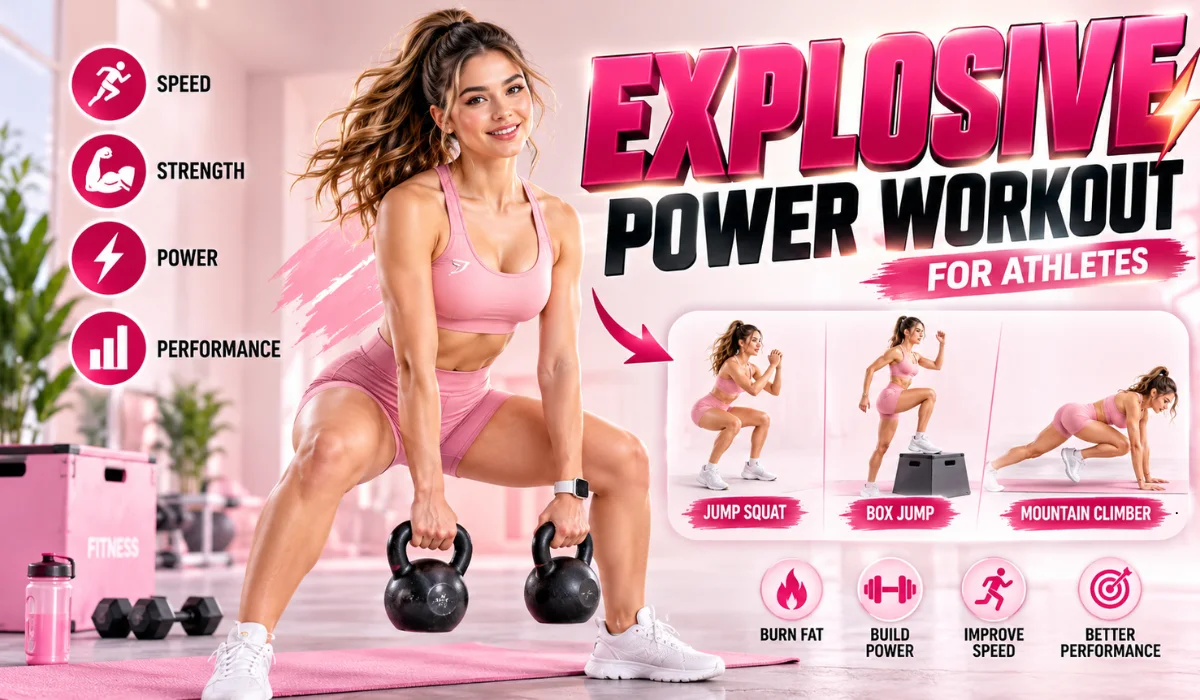
Try this simple 3-day weekly routine. For Day 1, focus on the lower body by doing box jumps for 4 sets of 5 reps, kettlebell swings for 3 sets of 8 reps, and walking lunges with a hop for 3 sets of 6 reps per leg. For Day 2, focus on the upper body and core with plyometric push-ups for 3 sets of 5 reps, medicine ball slams for 4 sets of 6 reps, and plank shoulder taps for 3 sets of 20 reps. For Day 3, focus on full body speed and agility with broad jumps for 4 sets of 4 reps, resistance sprints for 5 sets of 15-yard dashes, and skater jays for 3 sets of 10 reps total.
Read Also: Best Workout Routine For Active Lifestyle: Stay Fit And Energized
What are the best explosive power exercises for athletes?
You do not need fancy gym machines to build elite athletic power. The best explosive power exercises for athletes use your own body weight or free weights to train your fast-twitch muscle fibers. Here are three foundational movements every athlete should master:
Kettlebell Swings teach your hips to snap forward with speed. Your glutes and hamstrings do the hard work, which protects your lower back. Box Jumps onto a sturdy box build incredible lower-body power. It trains your legs to absorb shock and explode upward instantly. Medicine Ball Slams connect your upper and lower body. Slamming a heavy ball into the floor builds vicious core and shoulder power.
Explosive power workout for athletes at home
You do not need a gym membership or expensive equipment to build world-class power. You can easily do an explosive power workout for athletes at home using just your body weight and a bit of floor space.
Here is a quick home routine you can do in your living room or backyard. Tuck Jumps require you to jump as high as you can and pull your knees up to your chest while landing softly on the balls of your feet for 3 sets of 5 reps. Explosive Dive Bombers are a dynamic push-up variation that builds shoulder and core power for 3 sets of 6 reps. Split Squat Jumps require dropping into a lunge, then exploding upward and switching your legs in mid-air for 3 sets of 4 reps per leg.
Designing Your Explosive power workout plan
Consistency beats intensity every single time. To get the most out of your training, you need a structured explosive power workout plan that fits into your regular sport practice schedule. Do power workouts 2 to 3 times per week, leaving at least 48 hours of rest between heavy sessions. Always do power work after your dynamic warm-up and before your regular conditioning or endurance work while your nervous system is completely fresh. Once an exercise feels easy, increase the difficulty by adding a small weight, jumping a little higher, or reducing your rest time slightly.
Power exercises at home vs. gym-based training
When working out at home, you rely mostly on body weight, plyometrics, and household objects. When working out at a gym, you can use barbells, kettlebells, resistance sleds, and heavy medicine balls. Both methods work wonderfully. If you are training power exercises at home, focus on the speed of your body weight. If you are in a gym, you can add external loads to challenge your muscles in new ways.
Speed training vs power training for athletes

Many young athletes get confused about the differences between training styles. Let us clear that up simply. Speed training focuses on how fast your limbs can move without heavy resistance, such as overspeed sprinting and fast footwork drills. Power training focuses on how much force you can apply against resistance in a short time, such as box jumps and heavy medicine ball throws. Both styles overlap and support each other. You need power to push off the ground hard, and you need speed to move your legs quickly through the air.
Explosive strength vs maximal strength training
Another common question is the difference between explosive strength vs maximal strength training. Maximal strength is how much total weight you can lift one time, like a heavy 1-rep-max deadlift. It is slow and steady. Explosive strength is how fast you can apply a fraction of that strength, like a basketball player leaping for a dunk. While maximal strength gives you a high ceiling of potential, explosive strength helps you actually use that strength during a fast-paced game.
Read Also: How to Build a Morning Workout Routine For Energy and Focus
Expert Insights and Real-World Opinions
We spoke with professional strength and conditioning coach Marcus Vance about the truth behind athletic power development.
"The biggest mistake athletes make is training too slowly," Coach Vance explains. "They lift heavy weights for hours, but they never practice moving fast. If you want to explode past your opponent on the court, your training must match the speed of the game. Quality over quantity wins every time."
Frequently Asked Questions
Can beginners do explosive power workouts?
Yes, absolutely! Beginners should start with low-impact bodyweight movements like squat jumps and fast footwork before moving on to weighted exercises or high-box jumps.
How long does it take to see results from power training?
Most athletes notice improvements in their speed, first-step quickness, and jump height within 4 to 6 weeks of consistent, focused training.
Is explosive power training safe for joints?
Yes, as long as you focus on proper landing mechanics. Always land softly on the balls of your feet with bent knees to absorb shock and protect your joints.